Different games have different ways of scoring. For example, in table tennis it is the first to eleven or more points by a margin of at least 2 points. Until quite recently it was best to 21 or more points by a margin of at least 2 points. In some other games, like squash and volley ball you can only score a point if you win a point on your own serve. And in other games, like tennis, the scoring system involves a sequence of games and sets that must be won in order to win the overall match.

There are three main styles people use for the high jump - scissors, straddle and the Fosbury Flop (named for Dick Fosbury, who invented it). At school, people are often taught scissors first, and only go on to the other styles if they show promise. Why do you think good jumpers don't use the scissors style. What do you think is the advantage of the Fosbury Flop?

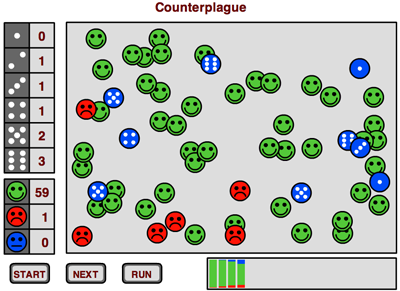
e-Counter Plague screenshotImagine your school.  Someone in your class comes in one morning with e-Counter Plague.  Who will get it?  Will everyone in the class?  Or will some people be OK?  How about other classes?  Will it spread to them as well?

e-Counter Plague screenshotImagine your school.  Someone in your class comes in one morning with e-Counter Plague.  Who will get it?  Will everyone in the class?  Or will some people be OK?  How about other classes?  Will it spread to them as well?

Football has a simple scoring system, but other games are not so simple. Games like tennis, badminton, squash, volleyball have quite complicated scoring systems. In some games, like badminton and volleyball, you can only win points on your own serve. Games like tennis and table-tennis require you to win the best of 3 or 5 sets/games.

Does being big help in sport?

In some events being big is an advantage, in others it is a hindrance. Weightlifters need to be as big as possible for their weight category, shot putters need weight to enable them to propel the shot as far as possible. However long distance runners need to be light, so that they are not wasting energy on carrying body weight.

Speaker: 
Jenny Gage
Participating school(s): 
St Joseph's College, London
Date: 
Friday, October 15, 2010
Time: 
10.35 - 12.05
Age range: 
Year 11
Cost: 
£230 for up to 90 minutes

An enrichment session for Y11 students studying for their terminal GCSE exams.  We will look briefly at the history of the quadratic equation and why it is so important.  Then we will use a spreadsheet for practice in factorising QEs and to consider how the equation and the solutions relate to the graph.  The main part of the session will be a practical investigation of a mathematical model for a falling object.  There is also a problem to solve about a drop goal, which could be used for follow-up work if there is insufficient time in the session to tackle it.

Syndicate content